Our emerging project definition of ‘big data’ is data that is incrementally larger than anything people have had to deal with before, in a given field.
— Lynette Taylor (2013) “Big Data in the Developing World”

 “Raw Data” is both an oxymoron and a bad idea.
— Geoffrey C. Bowker, Memory practices in the Sciences

 A simple twitter search for the #data hashtag today will provide the user with a real-time glimpse of the evolving nature of data and its social ramifications. “Big”, “semantic”, “open” and “mobile”, are only some of the conditions of data today.  After interacting with these terms, it quickly becomes clear that data does not appear to be neutral nor natural and that, as a cultural construct, the study of data requires new critical approaches to chart and explore its human and social implications.

In this sense, the book “Raw Data” is an Oxymoron (2013) recently published by MIT Press and edited by Lisa Gitelman — Professor of English and Media, Culture, and Communication at New York University — could not be more timely. The book contains “eight episodes in the history of data” by a number of renowned scholars concerned not only with the digital, but also the pre-digital condition of data. The introduction to the book, written by Gitelman and Virginia Jackson recognizes that “the new millenium has arrived as the era of Big Data”, and that there is “a seismic shift in the contemporary conception and use — the sheer existence — of so much data” (2). This new era requires critical explorations on the generation, protection and interpretation of data (12).

— View full post here.


we-should-be-software
Transcript and slideshow of a paper presented at the 2013 Neil Postman Graduate Conference

— Download Presentation Text with Images (English)
— Descarga Texto de la Presentación (Español) — ¡Muy Pronto!

Abstract

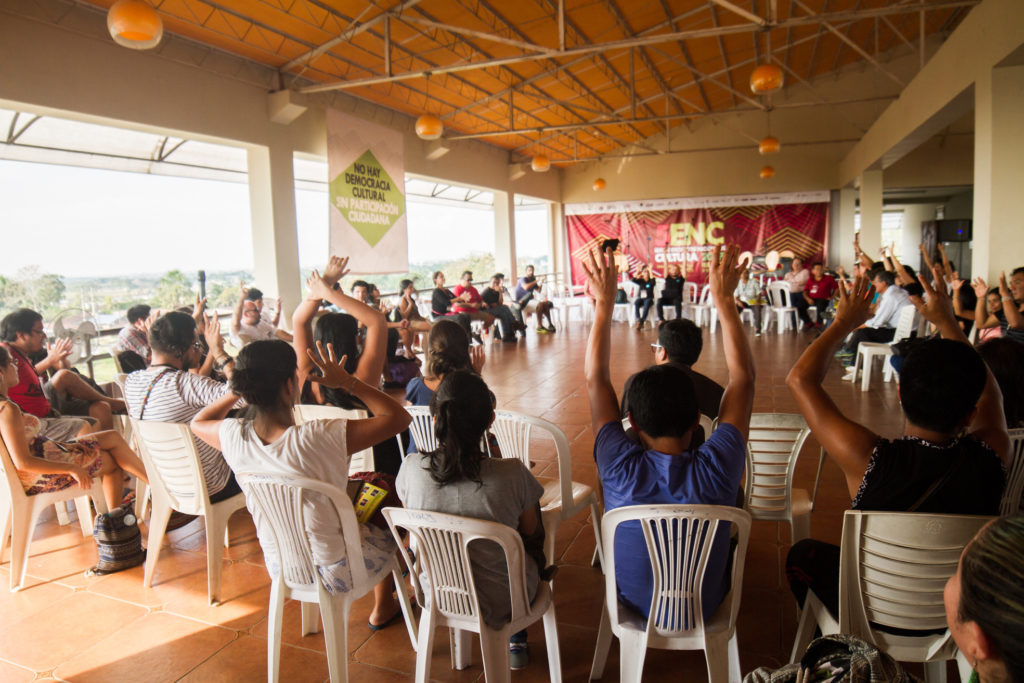
In recent years, Latin America has witnessed the appearance of various “cultural networks” composed of arts and culture organizations, directly influenced by digital media and networked technologies. These networks have impacted policy spaces while forming alternative circuits for cultural production, consumption and valuation, within their countries and across national boundaries. They can be understood as a reaction to vertical cultural policy-making (generally focused on the promotion of fine arts and archaeological heritage) and widespread institutional opacity and government centralization in the region. Cultural networks advance a plurality of socio-political agendas and broaden the spectrum of collective aspirations surrounding culture and its relationship to social development. Continue reading

salvemos-las-huacas-comas

Versión en español en el sitio de Salvemos las Huacas

About Salvemos las Huacas

On January 2013, Culturaperu.org, La Factura, Alta Tecnología Andina (ATA), el Collectivo Colli and Tándem GCD, a group of organizations interested in cultural heritage and social development, launched the project “Salvemos las Huacas” [Save the huacas] in coordination with the Municipality of Comas and with the support of a mini-grant provided by the Interamerican Development Bank (IDB).

The project aims to use new technologies to sustain and strengthen local networks of students, teachers, public schools and community leaders, aimed at preserving archaeological sites in Lima, Peru. The initiative includes (1) the development of a Website (salvemoslashuacas.pe), (2) a set of workshops on cultural heritage and technologies and (3) the creation of a “Guide” for local educators and promoters. The project aims to develop this first stage as a pilot project, and later replicate this strategy on other districts in the city.

What is a Huaca?

slh_screen_capture_web_Feb-8-2013

The Encyclopaedia Britannica defines huaca — also spelled wak’a (Quechua: “sacredness,” or “holiness”) — as an ancient Inca and modern Quechua and Aymara religious concept that is variously used to refer to sacred ritual, the state of being after death, or any sacred object.

The Spanish conquistador Pedro de Cieza de León believed that the word meant “burial place.” Huaca also means spirits that either inhabit or actually are physical phenomena such as waterfalls, mountains, or man-made shrines. The aforementioned shrines, which are found throughout the Inca territory from Ecuador to Chile, may be as simple as stones piled in a field (apachitas) or as complex as stepped pyramids that were once topped with canopies and carved images.

Photos, Top: Salvemos las Huacas and Sientemag | Right: Screen capture of website.

En la última década la región Latinoamericana ha visto emerger una serie de nuevos movimientos sociales desde agentes y espacios culturales diversos que buscan transformar la manera en cómo entendemos la relación entre cultura y desarrollo humano. Se trata de nuevos liderazgos, agendas y repertorios culturales para la emancipación y la transformación social que retan directamente las estructuras tradicionales y hegemonías que sostienen el diseño de políticas culturales en países como el Perú.

En esta conversación, Mauricio Delfin (Director de Culturaperu.org) describirá cuatro ejes de acción cultural (cultura viva, cultura libre, cultura abierta y cultura en red) que prometen transformar la forma en cómo entendemos no sólo la relación entre arte y cultura, sino también la función del gestor cultural y la naturaleza de las políticas culturales tanto a nivel local como nacional y global. Continue reading

The following is the slideshow I used for my presentation as Research Associate of the Trauma and Global Health Program, at the Global Health Research Initiative: Teasdale-Corti Program Symposium “Innovations in Global Health Research” - Global Social Justice and the Social Determinants of Health: Setting the Course for the Future, which took place in Ottawa on October 1-3, 2012: