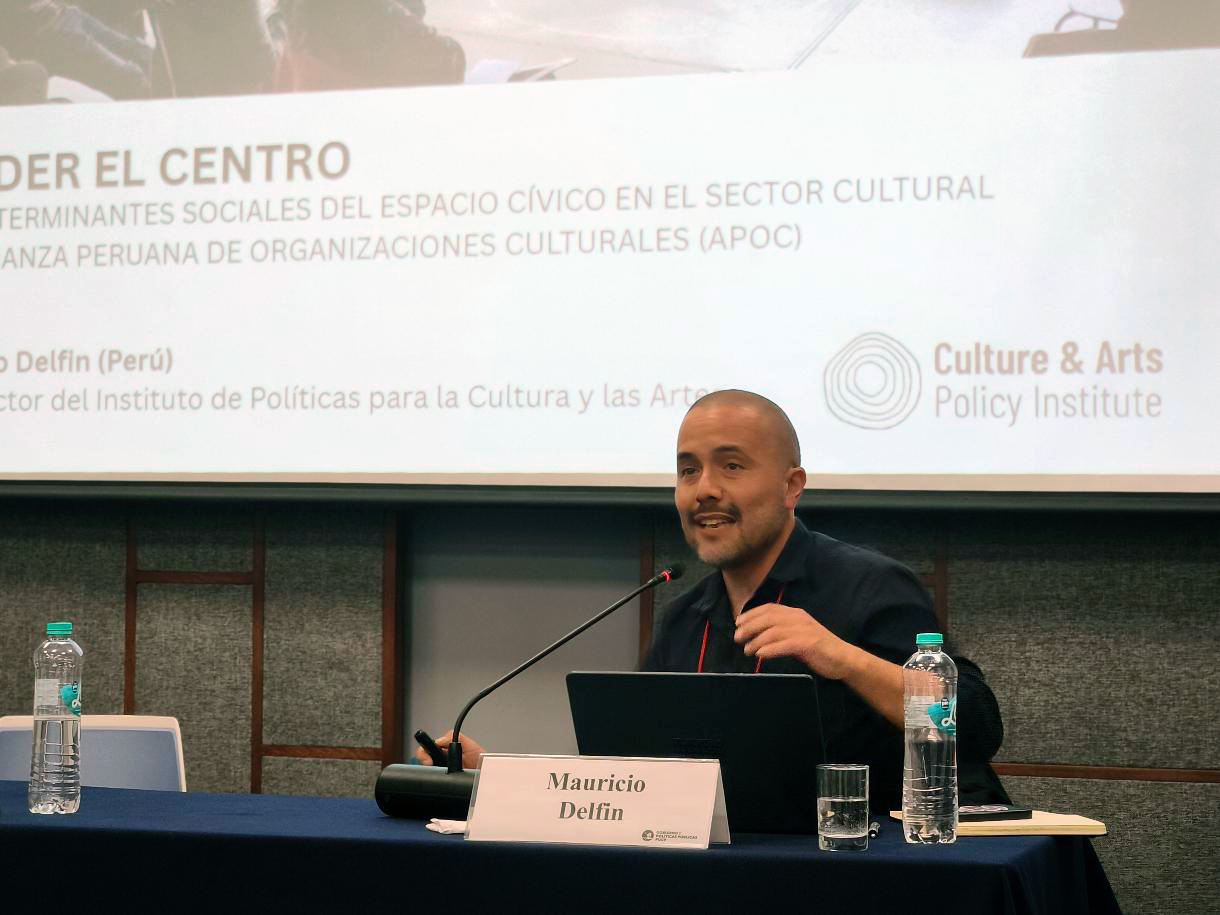
Yesterday, I had the opportunity to present my research on “The Social Determinants of Civic Space in the Culture and Arts Sector: Interpretations on the experience of the Peruvian Alliance of Cultural Organizations (2017-2021)”. My paper was part of the panel “Cultural Governance: Institutions, Multilateralism and Civic Space”, chaired by Fabiola Figueroa | (Peru), with the participation of Flora Maravalhas (University of Lisbon), Sofia Lobos (Chile), and Martin Inthamoussu (Catholic University of Uruguay). The panel took place as part of the Global Dialogue organized by PUCP and Cultural Trends in Lima, Peru.
My paper described civic space as a space for political imagination and action, whose contours are set by
overlapping political, administrative, economic, and cultural forces. I used the case of the Peruvian Alliance of Cultural Organizations (APOC) — a trans local network of 14 arts organizations across five regions of Peru that was active from 2017 to 2021.
The Social Determinants of Civic Space in the Culture and Arts Sector
In this work, I interpret APOC as a deliberate attempt to expand civic space in Peru’s cultural sector, countering the structural constraints that stifle participation and voice. My paper – the first of a three-part series — shows how APOC members co-designed practical mechanisms to build trust, cultivate political agency, welcome productive disagreement, and model alternative institutionality. Employing and expanding the concept of infrastructuring (Nehl and Landau-Donnelly, 2025), my paper argues that these practices represent a form of civic imagination in action—assembling a shared infrastructure that redefines what cultural governance can be. The conclusion offers transferable lessons for organizations in the global majority seeking to expand civic space in similarly restrictive contexts.